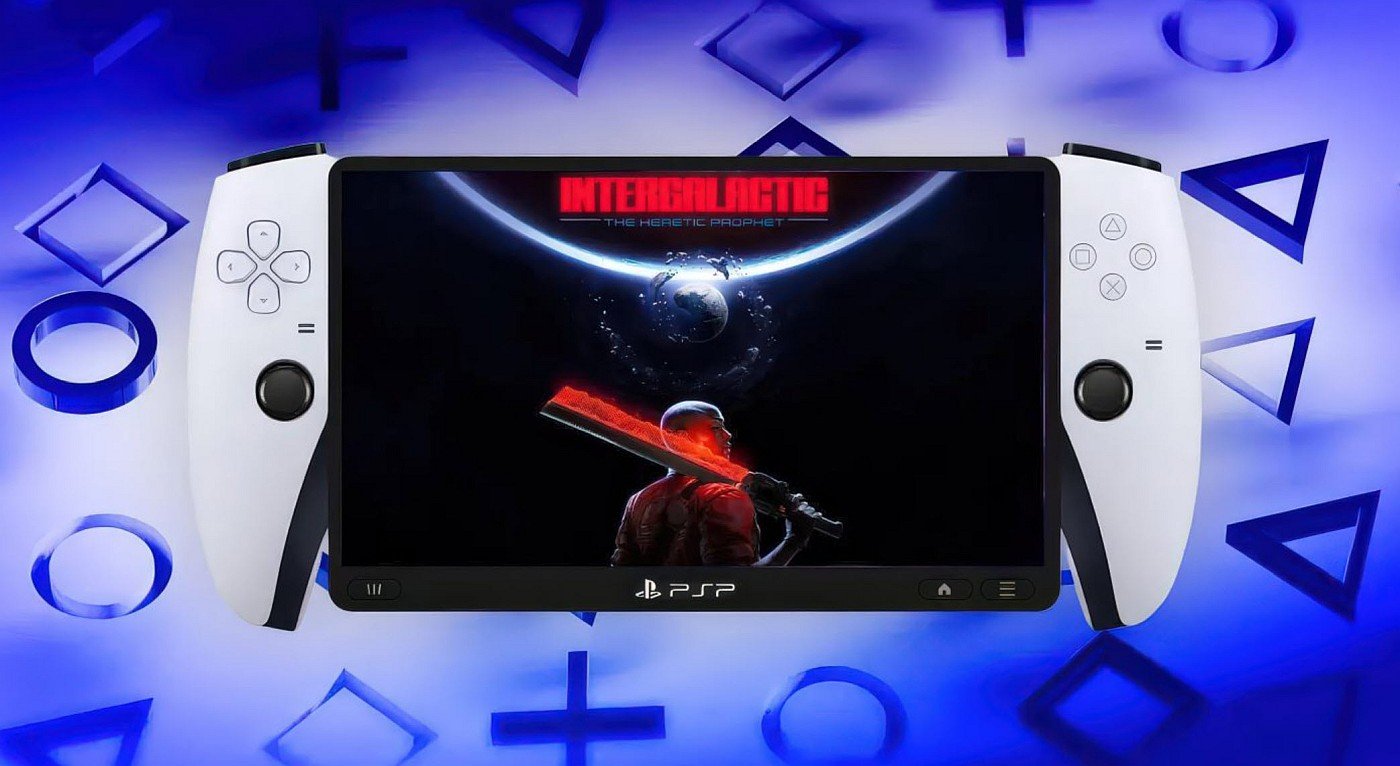
Sony’s rumoured PS6 handheld, reportedly developed under the codename Project Canis, has appeared in another substantial hardware leak. The portable console, also informally described as “PSP 3,” could rely on relatively modest native rendering combined with an advanced version of PlayStation Spectral Super Resolution to deliver visuals approaching those of much more powerful home consoles.
According to information shared by GameGPU, Project Canis uses a custom 3 nm AMD processor with six Zen 6 CPU cores. The configuration reportedly combines four Zen 6c performance cores with two energy-efficient Zen 6 LP cores. The chip would be paired with 24 GB of shared LPDDR5X memory connected through a 192-bit bus, while the entire system would operate within a strict power envelope of 15 to 25 watts.
Graphics would be handled by 16 Compute Units based on AMD’s upcoming RDNA 5 architecture. In portable mode, the GPU is expected to operate at 1.2 GHz and deliver around 4.91 TFLOPS, increasing to 1.65 GHz and 6.75 TFLOPS when docked. Those raw figures remain well below the PS5 Pro’s 16.7 TFLOPS, but direct TFLOPS comparisons across different GPU architectures can also be misleading.
The more controversial part of the leak concerns rendering resolution. Project Canis may render demanding games internally at just 540p before reconstructing the image to the handheld’s native 1080p resolution through PSSR 3.0. This upgraded technology is also said to support frame generation, allowing Sony to produce smoother output without requiring the GPU to render every displayed frame conventionally. On a relatively small handheld screen, a well-reconstructed 1080p image could look considerably sharper than the 540p base resolution suggests.
GameGPU estimates performance equivalent to 10–11 TFLOPS in portable mode and around 14 TFLOPS while docked, potentially placing the perceived results close to PS5 Pro territory. However, these should not be treated as actual compute figures: upscaling and frame generation improve image quality and apparent fluidity, but do not increase native GPU power. Previous reports have nevertheless suggested that Canis could outperform Xbox Series S in rasterisation while holding a much larger advantage in ray tracing.
Sony is reportedly targeting a late 2027 release for Project Canis, although neither the handheld nor its specifications have been officially confirmed.
via wccftech